Saturday, April 27, 2013

Testing Different Clay Bodies

High Fire Grollegg Porcelain
When our class was introduced to testing different clay bodies, I knew right away that I wanted to play with a very white clay body.  My professor Paul Donnelly gave me a couple of different recipes that contained high amounts of grollegg.  I ended up choosing Babu's porcelain and testing that.  It was more difficult to throw and trim with but it was extremely hard to pull handles with because of it's plasticity.  After taking mixing up a slip slurry of it and letting it dry on plaster it was a lot easier to pull handles with.
  
High Fire Black Stoneware 
The second clay body I tested was a black stoneware.  I mixed up a one pound slurry of slip and laid it out on plaster until it was firm enough to wedge up and throw.  This was by far the best all around clay body I have ever worked with.  It looks like dark chochlate when you are throwing with it and it fires beautifully with just a clear glaze over it such as Hensley Clear. 

                                    
Flint Hills High Fire Stoneware
The last clay body I worked with was from Flint Hills Clay and it was just their high fire stoneware.  This clay body reminded me of other stoneware's I have used in the past.  It works really nice to throw with and it is not that firm so it easy to wedge large amounts.  It is a very strong clay body so it makes it easy to trim a lot off when leather hard.  This clay body is also quite beautifiul with just a clear glaze over it and looks even better with black under glaze designs if applied in the correct amount.  

Thursday, April 25, 2013

From the potters wheel to the plaster wheel.

The Plaster Wheel
This was the first time I learned how to work with plaster and the plaster wheel.  You start by rolling up a plastic tube and setting it center on the wheel head.  Once you have that plastic dammed up around the sides with clay you pour plaster in the tube to the height that you want your piece to be.  Depending on the size of the piece you unroll the plaster and begin to lathe the plaster block into whatever your heart desires.  Once you have the form you want you soap it and repeat the first step and make a crack mold.  This is a cup I made where I lathed it upside down.  

George Timock
Words can not even desribe George Timock, but I will try.  He is the most talented, hard working, and dedicated ceramic artists/teacher I have ever worked with.  I only worked with him for 2 weeks here and there as he helped me learn about basic mold making.  However, I learned a lot from him but still have so much more to learn about molds.  I feel very fortunate to have had the oppurtunity to study and work along side of him.  


Pitchers assignment 2013 KCAI

Josh Deweese Pitcher
From the moment I first saw Josh Deweese's work I was in love with it.  I was surprised that I enjoyed it so much because for years I always admired tight forms.  Josh is able to compose pots that have a very loose feeling with his cut away rims, large attached spouts, and sometimes pretty crazy handles that are pulled and manipulated.  His gestural brush strokes also flow very nicely with his forms.

Ancent Greek Wedding Pitcher
I have always admired ancient Greek pitchers for their unique style and different form designs.  The Greeks composed different pitchers, amphoras, and some of them even just look like vases.  Some of my favorites are the ones that have pointed bottoms that rest in another pot.  I admire this wedding pitcher for its simplicity, size, and beautiful white slip application.

Jeff Campana Pitcher
Jeff Campana is working unlike any other ceramic artist that I have ever seen.  He throws these beautiful porcelain forms, then cuts them in leaf like patterns.  After he has his forms completely destructed, he reassembles them exposing the lines.  He is a master not only at this technique but glaze formulation and application also.


Start of Spring 2013 at KCAI

Sanam Emami
We started off the semester by making a variety of vase forms.  One contemporary ceramic artist I have always admired for her work but especially her vases is Sanam Emami.  Her vases are unlike anything I have ever seen before and her approach to setting up different spouts for the flowers to grow in remind me of how flowers actually bloom themselves.
Chinese vase made in Jingdezhen
I have always admired ancient and current Chinese ceramics.  They produce beautiful, elegant forms that are normally finished with a base glaze then highly decorated with china painted or cobalt oxides topaint beautiful scenes of nature.  

                                         
White Calla Lilys
For years I have always admired flower arrangements and also enjoy putting them together for special occasions.  I have only done it a couple of times for girlfriends and of course for my mom on mothers day.  It is even more fun when you get to fill one of your own vases that you made and see how the flowers want to position themselves.  


Tuesday, October 23, 2012

October 24, 2012

Chinese Landscape Paintings


I have always admired Chinese landscape paintings.  It is incredible how much depth and detail they show with simple mark making.  Several lines, dots, and shading come together to coney a beautiful depiction of a Chinese landscape.

Martha Grover


I am drawn to Martha Grover's porcelain for it's movement and color.  It is elegant yet simplistic in a way.  These dinner sets flow very nicely together in the stacked position.  Martha's pots are invitiing to the user and she a great sense of color with her glaze application.  

Chris Staley


Chris Staley's pots are about "fragility and strength."  He primarily makes vessels, some have tight forms but loose textures that are applied.  Some of his other pieces are more loose in form but have smooth surfaces.  I really admire his work for its craftsmanship and explorations in form.  


Wednesday, October 17, 2012

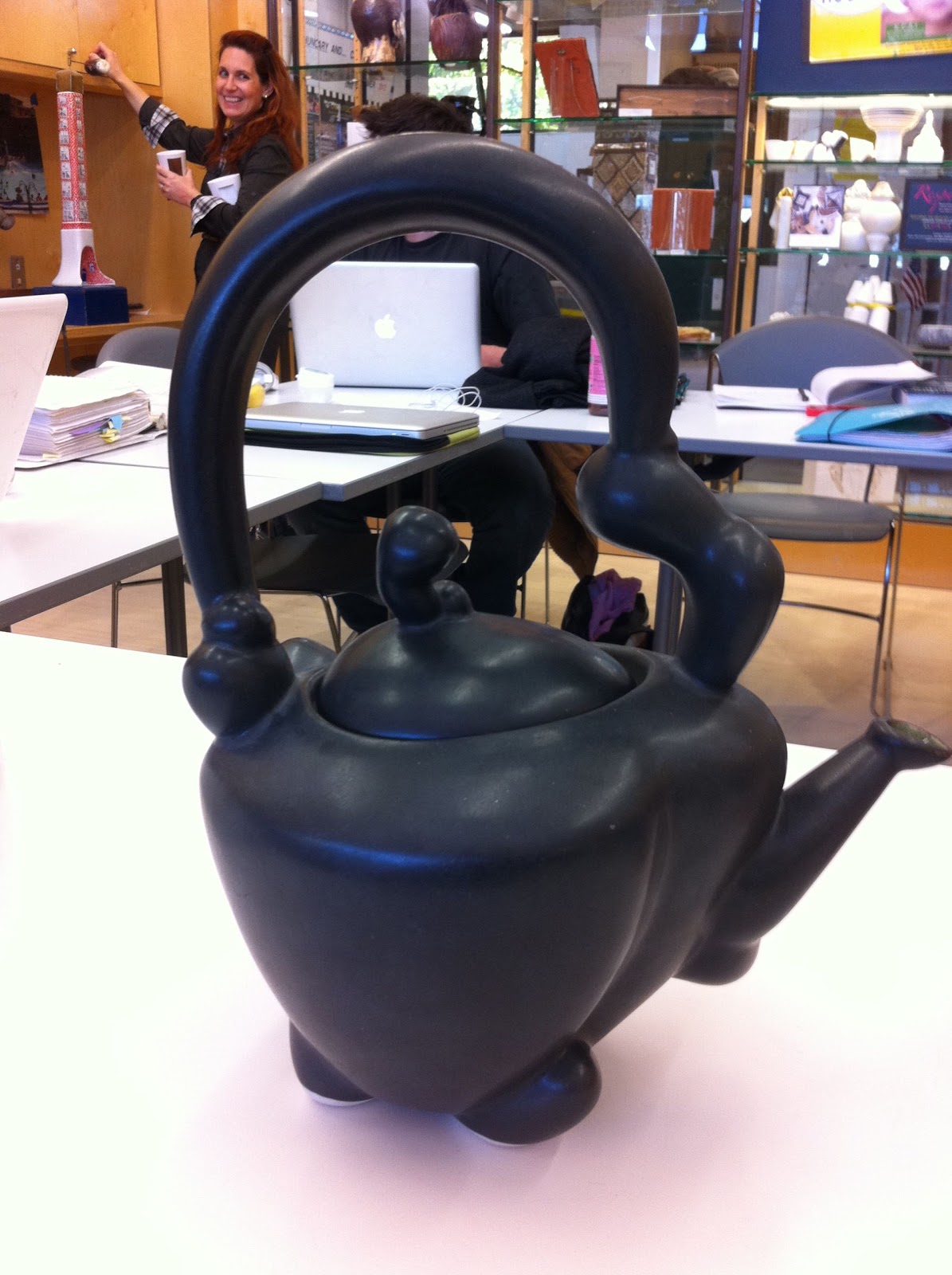
Arthur Gould
This slip cast tea-pot was really well done.  It has a lot of freedom and movement to it.  The artist made a wise choice by just glazing it in a black satin glaze so it does not take away from the form.  

Nathan Brunson
Although this large chalice looks relatively simple in form, the glaze is what stood out to be.  The amber celadon turned out really nice with the white drips over top of it.  There is an awesome red underglaze at the bottom of the piece too.  

Curtis Stewardson


I really adore ceramic baskets.  I have never seen one shaped like this before, with a very wide base and super thick handle this piece is quite different.  The interior blue glaze is really gorgeous as well as the glazes on top of the handle over the satin black.  

Tuesday, October 2, 2012

October 3, 2012

Michael Connelly
Earlier this year I had Michael as a teacher.  I really enjoy his work because of his tight forms with relatively loose glaze application.  

Tom Coleman
Tom Colemans work has always been an inspiration to me.  All of the lines and mark making he puts on his pots lead your eye all around the piece.   He then goes in and highlights his mark making with very bright vibrant colors.  

Glacier National Park
This picture of Glacier National Park is absolutely beautiful.  I love the landscape with the river flowing down the rocks, leading your eye up through the trees, to the mountain top that is still blanketed with a bit of snow and the sun setting in the background.